
Sleep Health for Infants and Mothers
An interview with Christina Hamill in collaboration with Rest House Sleep
Few things shape the early months of parenthood more than sleep — how much of it everyone is getting, and how peaceful it feels. So we teamed up with Rest House Sleep to sit down with Christina Hamill, a local craniosacral practitioner with deep experience supporting babies, children and parents.
Christina is a member of APPPAH (the Association for Prenatal and Perinatal Psychology and Health), the organization behind public recognition of Birth Psychology Month, and a Pre and Perinatal Educator. In 2016, she began bringing awareness to birth psychology in her community of Duncan, BC.
We asked her how parents can help their little ones settle into the most restorative sleep possible. Here's what she shared with us.
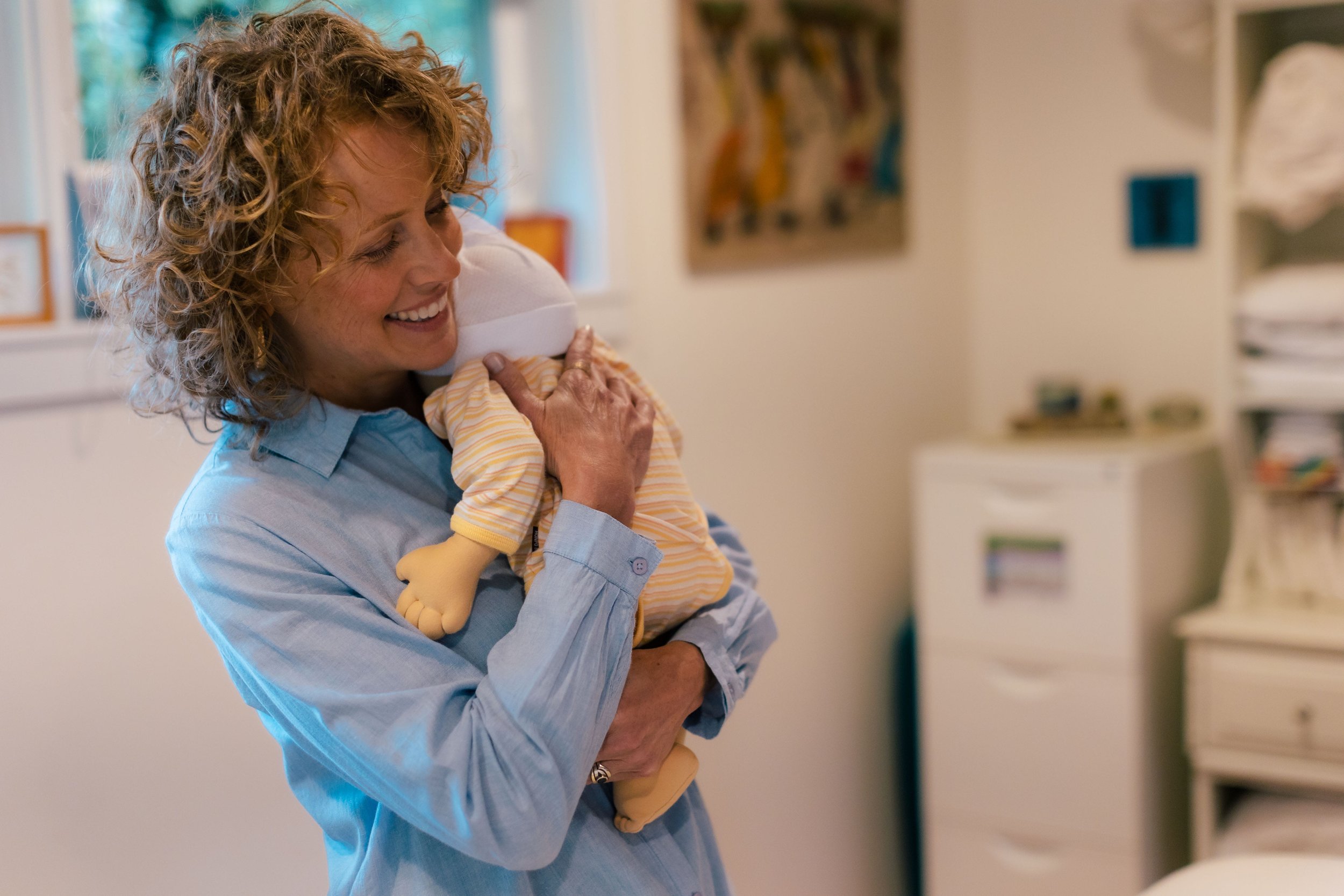
Tell us about your experience working with babies and children.
It's quite diverse: from being a nanny, to teaching preschoolers and teens in Japan, to running my own daycare so I could stay home with my baby daughter. I later discovered a holistic Infant Toddler program that deepened my understanding of children. Part of it included embryology — the study of embryo development — which got me interested in broadening my work to support mothers and babies during pregnancy and birth. That motivated me to take two doula trainings to add to my skill set.
As a daycare provider, parents frequently asked me for guidance with their children. Taking the Simplicity Parenting Coach training gave me further skills to meet them in their questions and offer practical tools. I'm a constant learner of child development, regularly attending conferences and workshops to meet my own curiosity, reflect on it, and discover new insights.
How did you get into craniosacral work?
When my daughter was younger, she had two head injuries. I asked her teacher what she recommended to further support my daughter's recovery, and she suggested craniosacral therapy. At the time, we had to travel to Victoria for appointments. During a visit, I noticed a flyer in the waiting room for a biodynamic craniosacral therapy training, and I realized the Cowichan Valley needed a local biodynamic craniosacral therapist. I took the training, and the rest is history.
How important is sleep to a baby's emotional and physical development, and how can parents prepare their baby for it?
Sleep is a sensitive time for babies, both consciously and subconsciously. Consciously, because falling asleep can feel like a separation, and that can trigger all kinds of unsettling, anxious emotions. Subconsciously, because this is a crucial time when their body is recuperating, restoring and developing at the deepest level.
One of the best things parents can do is establish a consistent daily rhythm from morning until night. It cues their baby for what's coming and makes transitions easier.
Babies need to be gently and lovingly supported and reassured when crossing the threshold into sleep. They need a calming, consistent sequence of actions that prepares and cues them. It's practical to learn a short nursery rhyme and a lullaby by heart, and to include soothing touch. Babies love repetition, so I encourage parents to choose a rhyme and song they like. The bonus of hearing their own parent's voice is that it activates the neural pathways for speech and language development.
Another very important aspect of quality sleep is providing babies with 100% natural, breathable sleepwear and linens, along with chemical-free bedding — whether you're using a crib, a co-sleeper, or co-sleeping directly on your own bedding. Synthetic materials aren't breathable, and the energy a baby expends negotiating body temperature competes with the body's intuitive time to restore. A baby's sleep is a sacred time. It's wise to protect babies from chemicals, because when toxicity bombards the nervous system it weakens the vital forces they need for optimal growth and development.
What signs suggest a baby is struggling with sleep?
Babies are good at showing when they're struggling with feeling tired. They tend to have droopy eyes, rub their eyes, disengage from eye contact, rub or pull on their ears, get irritable, nuzzle their head into mum or dad's chest or a blanket, and can look "tipsy" or lethargic. It's best to cue babies for sleep before they're overtired. Gradually establishing a daily rhythm supports healthy sleep habits and ideally prevents struggles altogether.
With my maternity clients, I actually encourage sleep rhythms to be established as early as during pregnancy. Parents can start reading a story and singing a lullaby to their unborn baby at regular times. Parents who do this notice how quickly their baby is soothed and ready for sleep when the same story and lullaby are used after birth.
Basic struggles can be the result of the daily rhythm being interrupted — travelling, or too much stimulus. When parents keep this in mind, they can stay calm and integrate strategies like taking pauses to connect with their baby in a quiet place, which softens the impact of an off rhythm. Sleep struggles can also come from a growth spurt, extra hunger, or not feeling well. Babies and children are often sick in the middle of the night, so it's ideal for parents to have a first aid kit that includes some holistic remedies. I also recommend the Lilipoh Children's Health Guide, published by the Wellness Nurses of the Los Angeles Alliance for Childhood.
When sleep struggles are chronic, I'd suggest parents take their baby to their family doctor and to a craniosacral therapist, because it's likely there was a complication in utero or during birth — with mum and/or baby — that's inhibiting healthy regulation of the autonomic nervous system.
What kind of treatments do you offer babies, and what changes do you notice?
Biodynamic Craniosacral Therapy (BCST) is a gentle touch therapy that's safe for babies and ideal for them, because they respond so well to it. BCST tunes into the health already present in their system, which initiates a healing response in both the fluid and fascial networks. This promotes the release of tension patterns, making it possible for the body to realign itself. Each baby has unique healing priorities, so treatments vary.
Pregnant mothers see me throughout their pregnancy for general health support and stress management, knowing their health affects their baby's health. They also come for support with prenatal bonding, especially if they've experienced previous pregnancy loss. Sometimes mothers come when their baby is malpresenting — not in the ideal position for birth. So you could say I treat babies via their mother as early as in utero.
Parents usually ask for newborn treatments when they notice something feels "off," or when they're aware the birth experience was traumatic. I also treat babies for torticollis, misshapen heads, digestive issues, sleep issues, and more. Parents come to see me when mum and baby are having breastfeeding challenges and/or there's a suspected tongue tie — I'm trained to assess for true and faux tongue tie, and in craniosacral therapy specific to supporting successful infant breastfeeding.
The changes we notice in babies are quite amazing. During a session, parents often say they've never seen their baby so calm. We witness babies going into dreamy places, letting go of tension patterns, and settling deeply into their bodies. They can also express emotions for the first time, when there was no space or support to do so before, and release any related holding patterns.
Any final words for parents about sleep?
Adjusting to a newborn at home is so much easier when lots of support is in place ahead of time for the first six months: meals in the freezer, a diaper service, someone to clean the house. If mum is stressed and tired, baby will feel it and become stressed and tired too. Babies are a whole sense organ — they feel everything.
I'm a huge advocate for layers of support for parents, because it gives them time to be relaxed and have skin-to-skin time with their baby. That establishes a sense of calm and safety in the baby's amygdala — the part of the brain that detects emotions and prepares for survival situations — making it easier to settle into deep sleep. I know mothers have heard this time and time again, but it really is so important that mum sleeps when baby sleeps. If a mother's autonomic nervous system isn't regulating, neither will her baby's.
Christina Hamill is the founder of Early Beginnings Wellness in Duncan, BC, offering biodynamic craniosacral therapy, lactation support, and newborn and pediatric care. She practises at Sol Centre in Duncan, BC, and offers online sessions to families across Canada. Book a 15-min free consultation at earlybeginningswellness.com/discovery.